
|

|
In this issue
|
Happy almost-August. You noticed the name at the top.
For nine issues this was The Operator's Edge. After some real marketing due diligence this summer, it is now The Company Builder's Manual. The new name says what this actually is: a working manual for people building companies with AI inside them. Same Wednesday, same desk, new masthead.
This first issue under the new name is the right one for it: why the things you build should outlive the things you buy. And at the bottom there is a new kind of field note, a personal one, about starting with AI later in your career. If you have been telling yourself the train left, read that one first.
Let's get into it.
You are making a hire, not picking a spouse
Claude is my pick today. Here is why nothing I built depends on that staying true.
|
Every week an owner asks me some version of the same question: which AI should I bet on? Claude or ChatGPT or Gemini, or the new one that launched while you were reading this sentence. Behind the question is a real fear. You are about to spend money and habit-forming months on a tool, and the field will not sit still.
Here is the answer I give, and it is the whole issue: a model is an employee. Talented, fast, occasionally wrong, and replaceable. Your company survives any single hire leaving because the company is not the hire. It is the roles, the process, the files, the customer knowledge. The thing you should be building with AI is that company, not a deeper attachment to one employee.
I use Claude, and I will tell you plainly why. Every company I work with needs the same things done: proposals drafted, contracts read, questions answered out of their own files, the repeatable work run without babysitting. Claude is the strongest hire for that work right now. Not because a benchmark says so, but because it holds a two-hundred-page document without losing the thread, follows a standing brief the same way on Tuesday as it did on Monday, and connects to the tools the business already runs on. I use it every day, in my own company and in my clients' companies, and that daily use is the whole basis of the recommendation.
But notice what I did not say. I did not say "and it always will be." Nobody can say that, and anyone who does is selling you something. If your setup dies when your model choice changes, you have not built anything. You have subscribed to something.
And the field has already proven it will not sit still. Two years ago the default answer was ChatGPT, full stop. Then Claude took over the working crowd, one contract review and one long document at a time. This year, open models out of China started landing near the front of the pack at a fraction of the price: DeepSeek, Kimi, GLM. I have GLM 5.2 and Kimi on my own test bench right now, not because I plan to switch, but because watching the bench is part of running the system. Five names are in the race today. Nobody serious will promise you the same five in two years.
The labs themselves force the issue. Every major provider retires old model versions on a schedule. The tool you buy today sits on a model that will be swapped underneath it, and the swap changes behavior in small ways you only notice in your own work. Switching is not a risk you might face someday. It is the maintenance schedule of this entire industry.
So here is what the system is, the part you actually own. Four things, and none of them is the model. Walk through them slowly, because this short list is the whole defense.
First, your instructions. The standing two-page brief that tells any AI how your company works: what you sell and to whom, how you talk to customers, the rules that never bend ("no quote leaves without shipping on it"), the words you never use. The test: a decent new hire could read it cold and get your company roughly right. Written as a document in your storage, it loads into any model ever made. Typed into an app's settings box, it belongs to the app.
Second, your knowledge. The folders the AI works from. Mine look boring on purpose: pricing, policies, past proposals, templates, one folder per client. The AI searches them. It does not own them. The test: if you cancelled every AI subscription tonight, every one of those files still opens tomorrow.
Third, your workflows. The repeatable jobs, written down the way you would brief a new office manager. When a lead lands: pull what we already know about them, score it against our three questions, draft the reply, flag anything over ten thousand dollars for me. That paragraph is an asset. Any competent model can execute it. In Claude, these written-down jobs are called skills, and each one is a file you own, which is exactly what makes the new record-a-skill feature in this week's Signal worth your attention. The same logic clicked together inside one vendor's builder is rent.
Fourth, your connections. The list of what the AI may touch and what it may do there: read the inbox but never send, read the calendar, read the books but read-only. It fits on an index card, and it should. If you cannot write your AI's permissions on an index card, you do not have a policy. You have a hope.
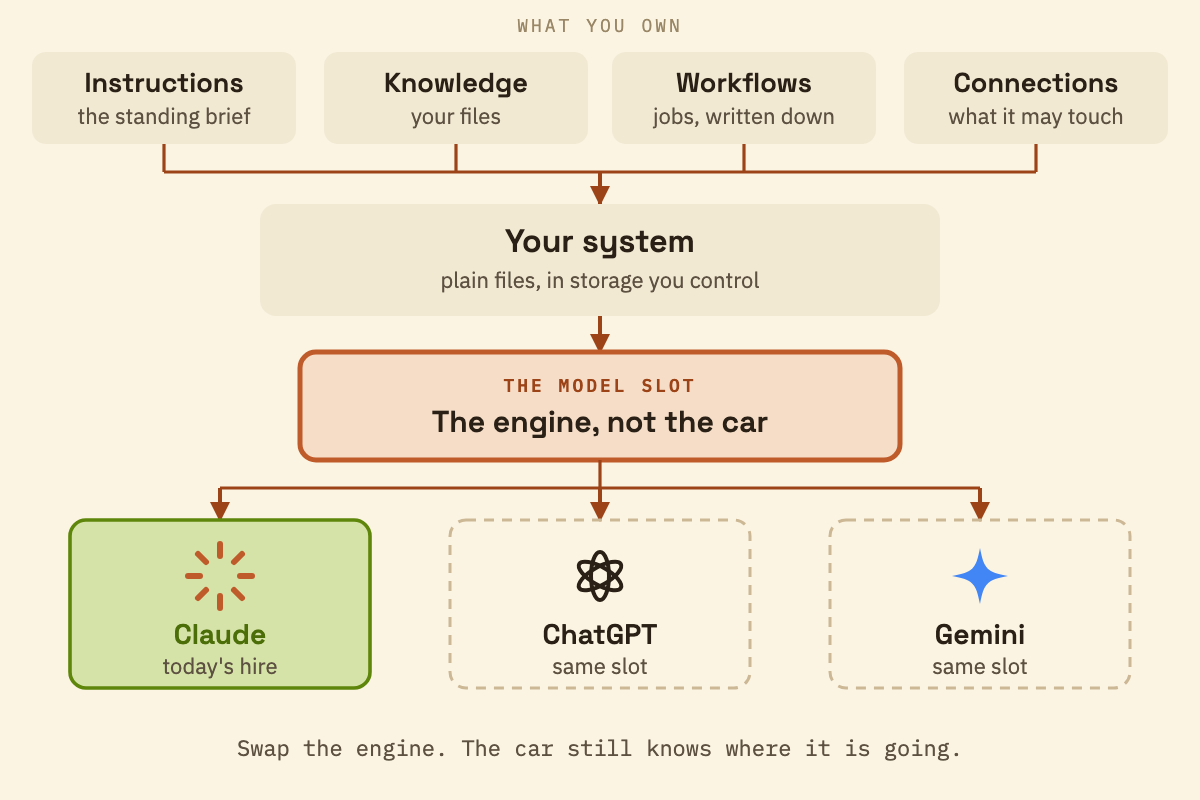
The model plugs into that system. It is the engine, not the car. Swap the engine and the car still knows where it is going. When I set up a company this way, the instructions, knowledge, and workflows are plain files in the company's own storage. If a different model becomes the better hire in a year, we point the system at it.
Let me be straight about what a switch costs, because it is not zero. A system tuned on Claude will not behave identically the day you point it at Gemini or anything else. Drafts sound a little different. A workflow or two needs its instructions re-tuned. The system survives; the polish takes some days to come back. That is a real cost, and it is nothing like the cost of starting over. It is also exactly why Claude drives today: right now it is the best foundation an owner, a founder, or an executive can build a real system on without it costing hundreds of thousands of dollars.
|
My desk
What this looks like in practice
|
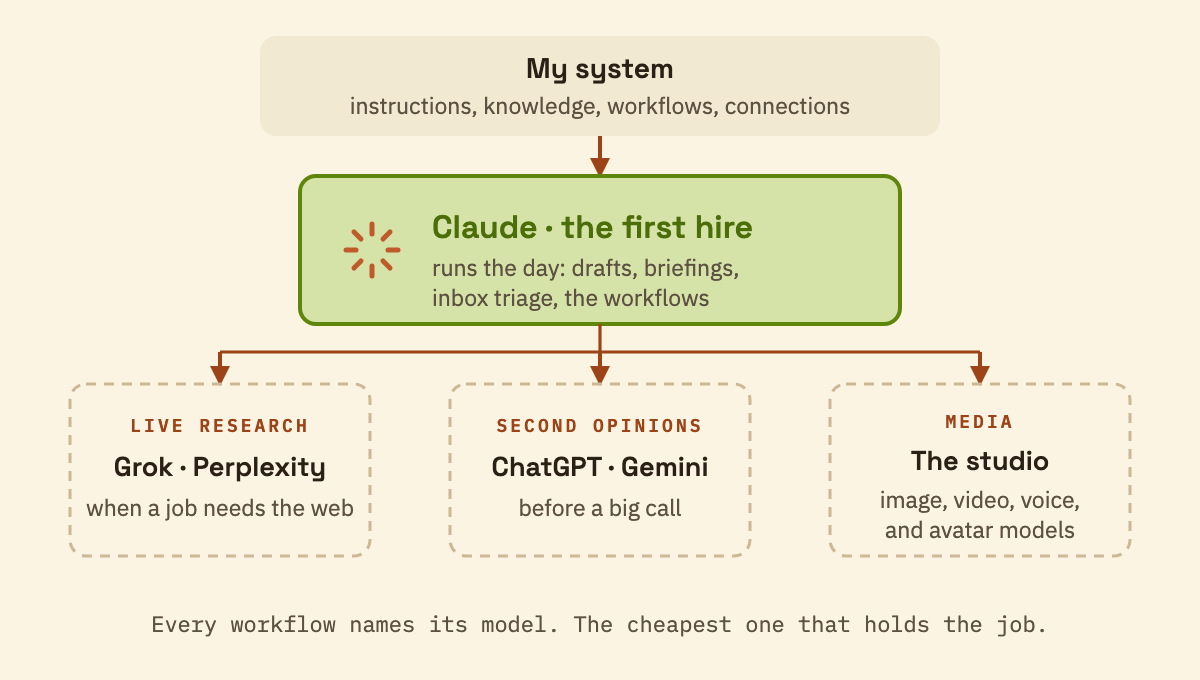
Here is my own setup, so this stops being theory. Claude is the hire that runs the day. It reads my files, drafts my client work, assembles my morning briefing, and triages my inbox on a schedule. It sits in the slot, and it is the one the others report to.
The rest of the bench gets called when its job comes up. A job that needs live web research goes out to Grok or Perplexity, because that is the one thing they are built for. Before a big decision, I ask ChatGPT or Gemini the same question I asked Claude and read the disagreement. And media runs on its own bench of specialists: image models, video models, voice models, avatar models, each one built for that single job, because a writing tool is the wrong hire for art.
The part that matters: none of them knows anything the others cannot be told. The brief, the files, and the workflows live in my storage, so handing a job to a different model is routing, not retraining. Every workflow in my company names the model it runs on, the cheapest one that holds that job. A two-second filing task runs on the cheapest, fastest model there is. The expensive thinker is saved for judgment. That is what keeps the bill flat while the capability grows.
|
The trap
How lock-in actually arrives
|
It is never dramatic. Nobody wakes up locked in. It arrives as routine mail, and one morning, a status page.
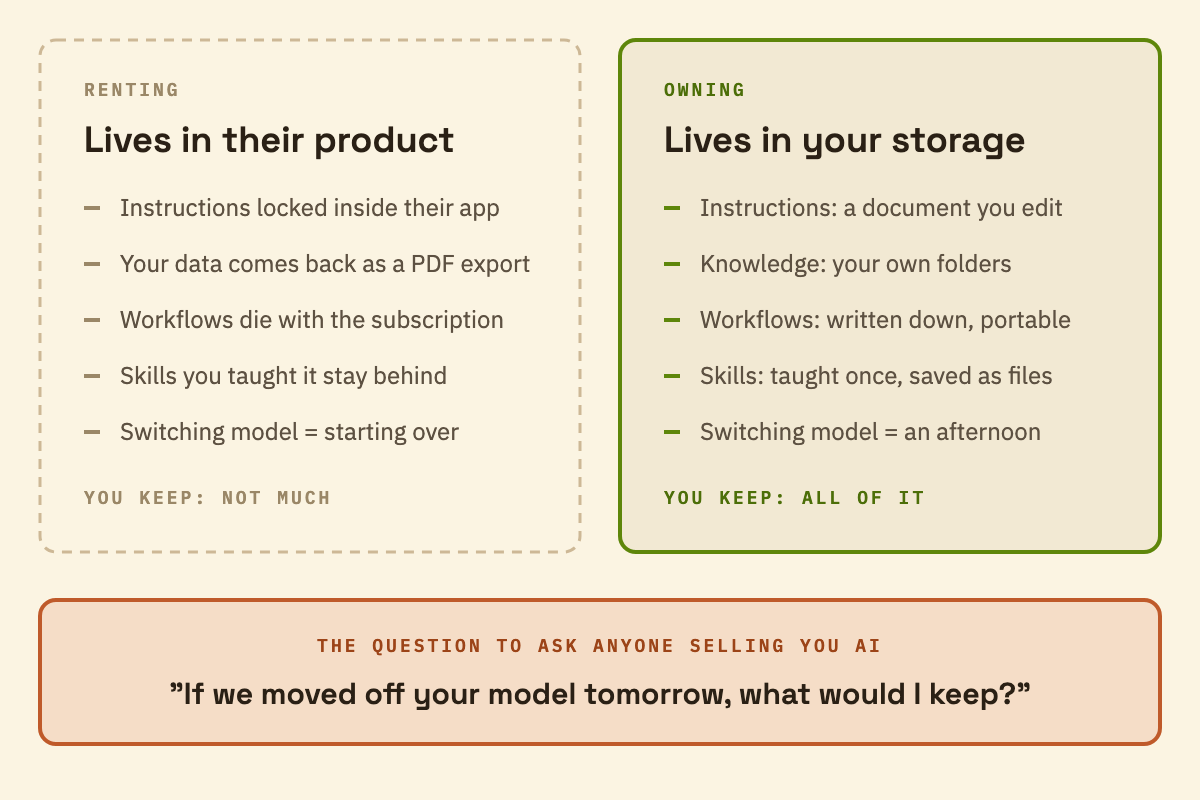
The retirement notice. The model under your tool gets swapped for a newer one, and behavior shifts in small ways: a different tone in the drafts, a rule quietly ignored. If your instructions are files, recalibrating is an afternoon of edits. If they are three years of tweaks buried in an app's settings, you are starting over and calling it an upgrade.
The renewal letter. Once your team's habits live inside a product, the price rises to just under whatever leaving would cost. That is not malice. It is gravity. Your negotiating position at renewal is exactly the size of your export folder.
The outage. Some mornings the model is simply down. Claude had one of those days recently, and every provider has them. With owned files, you point the system at a fallback model and keep working, a little less polished. With your whole operation inside one product, you refresh a status page and wait. Settle on one model with no way out, and a bad morning upstream is a dead day for you.
The export test. Ask any tool you are evaluating what you get if you leave. If the answer is PDFs of your own information, that is not an export. That is a goodbye card. Ask before you sign, while the answer still costs them something.
Now the money, because this is where it lands for your business. The subscription was never the real number. Twenty to forty dollars a seat is noise. The real spend is the hours you or your builder put into instructions, knowledge, and workflows. Spent inside someone else's product, those hours are rent, and they vanish the day you leave. Spent in files you own, they are an asset that survives every model release, every price change, and every vendor negotiation. Same hours, different balance sheet.
This is also the sharpest question you can ask anyone selling you AI. "If we moved off your model tomorrow, what would I keep?" Watch the answer. If everything you would keep lives inside their product, you are not buying a system, you are renting one. If the answer is "your instructions, your files, your workflows, all portable," you have found someone building you a company asset.
Three things this does not mean, so the idea does not get away from us. It does not mean use every model. Sprawl is its own tax, and most companies need exactly one daily driver. It does not mean hedge your commitment. Commit hard to the best hire today; half-commitment is where the value leaks out. And it does not mean models do not matter. They matter the way hires matter: a great one changes the company. You still do not rebuild the company around one person.
|
This week
Three moves, no builder needed
|
None of these needs a builder. Together they move you from renting to owning.
One: put your standing instructions in a document you own. The two-page brief on how your company works, what you sell, who your customers are, and how you talk to them. Write it as a plain document in your own storage, and paste it into whatever AI you use today. The day you switch tools, it comes with you.
Two: keep the files your AI works from in your own folders. Price lists, policies, templates, past proposals, in Dropbox or Drive, pointed at from the AI. Not uploaded one by one into an app you cannot export from. Your company's memory should not live inside someone else's product.
Three: ask the vendor question before you sign anything. It takes ten seconds, it costs you nothing, and the answer tells you more about what you are buying than the whole demo did.
|
The takeaway, for your ops lead at lunch
Pick the best model available today, and build everything around it as if you will replace it, because one day you will.
|
Four things worth your time
Expanded this week: what is actually in each piece, in two layers. Hit reply and tell me if the second layer earns its place.
|
1. The founder of a $20B AI company says the next gains are not bigger models. A 40-minute masterclass by the founder of Kimi (Moonshot AI), broken down by the Product Market Fit newsletter. His argument is that the frontier labs are converging, and the differences that matter now come from how models are put to work: many small jobs coordinated, checked, and given the right context, rather than one giant brain asked to do everything. When the people who build the models say the edge has moved outside the model, that is worth a minute of your attention. His lab shipped its next flagship, Kimi K3, this same week, which makes this a rare look inside a frontier lab's thinking while it ships. The breakdown
|
In plain English
Even the model makers say the winning move is the system around the model, not the model itself. The money you spend organizing your company's knowledge and workflows is the durable part of your AI budget.
|
|
The builder's cut
The claimed mechanics: split work into narrow tasks, run cheaper models on the narrow ones, reserve the expensive model for judgment calls, and let a coordinator route between them. That is also a cost story. It is why my own setup declares, per workflow, which model runs it: the cheapest one that holds the task.
|
2. "The bottleneck for AI agents isn't the model anymore. It's the context layer." The New Stack, arguing this issue's thesis from the infrastructure side. The claim: AI that acts on your behalf fails not because the model is dumb but because it cannot see your business. The fix is unglamorous plumbing: structured company knowledge, clear rules about which tools it may touch, and a record of what it did and why. The New Stack
|
In plain English
When an AI gives you a generic answer, the problem is usually not the AI. It is that nobody gave it your price list, your policies, and your history. Feeding it your company is the work.
|
|
The builder's cut
"Context layer" is the term of art for that feeding system: the compiled, structured version of your company's knowledge loaded into every AI task, plus guardrails and logging around tool use. It is the part you own and carry between models, which is why it, and not the model subscription, is the asset.
|
3. You can now teach Claude a skill by showing it one. New in Claude Cowork, announced on Anthropic's own channel this week: record your screen while you do a task, talking through it as you go, and Claude turns the recording into a saved skill it runs the next time that task comes up. Pro, Max, and Team plans, from the + menu in the desktop app. What caught my eye is the output. The "skill" it learns is a readable file you can open, correct, and keep, not a setting buried in an app. The announcement
|
In plain English
Teaching your AI a job now looks like training an employee: show the task once, and it writes its own manual. You can read that manual, correct it, and keep it.
|
|
The builder's cut
A skill is a plain text document describing a procedure, which makes it reviewable, versionable, and portable, exactly the property this issue is about. One caution from the practitioner crowd: writing a skill by hand forced you to think the task through, and recording removes that filter. Read what it wrote before you run it twice.
|
4. A CEO cancelled a $600,000-a-year Salesforce contract after his team built a replacement in two months. Fred Turner of Curative, the health insurer, told the 20VC podcast his company vibe-coded its own CRM, cancelled Salesforce, and plans to cut roughly 80 percent of its software subscriptions this year, spending on AI instead. Business Insider confirmed the cancellation notice with the company. Whatever you think of the bravado, the direction is the story: custom software that used to take a year and a vendor now takes a small team a season. Business Insider
|
In plain English
Do not fire your CRM this quarter. But the price of building custom software just collapsed, and every software renewal you negotiate from now on happens in that new world. Knowing it is leverage.
|
|
The builder's cut
Curative has an engineering team, which is the part the headline leaves out. The transferable lesson is not "build everything." It is that the build-vs-buy line moved, and the systems most worth owning first are the ones full of your own data and process. Same rent-vs-own argument as this issue's lead, one rung up the ladder.
|
One term, decoded
"Agent swarm," since it is in this week's reading and will be in a pitch near you soon.
|
"Agent swarm" is the phrase of the month. Here is the plain version. An "agent" in vendor language is an AI given a goal and permission to take steps toward it on its own. A "swarm" is several of them working at once, usually with one coordinating the others, the way a job site has a foreman and trades.
What it means when it is real: the work is split into narrow jobs, a coordinator hands each one to a model sized for it, and every handoff gets checked. The win is control and cost per job, not magic. The expensive model only touches the judgment calls. And the honest catch: run carelessly, a swarm spends more than one model would, because every extra step bills its own tokens.
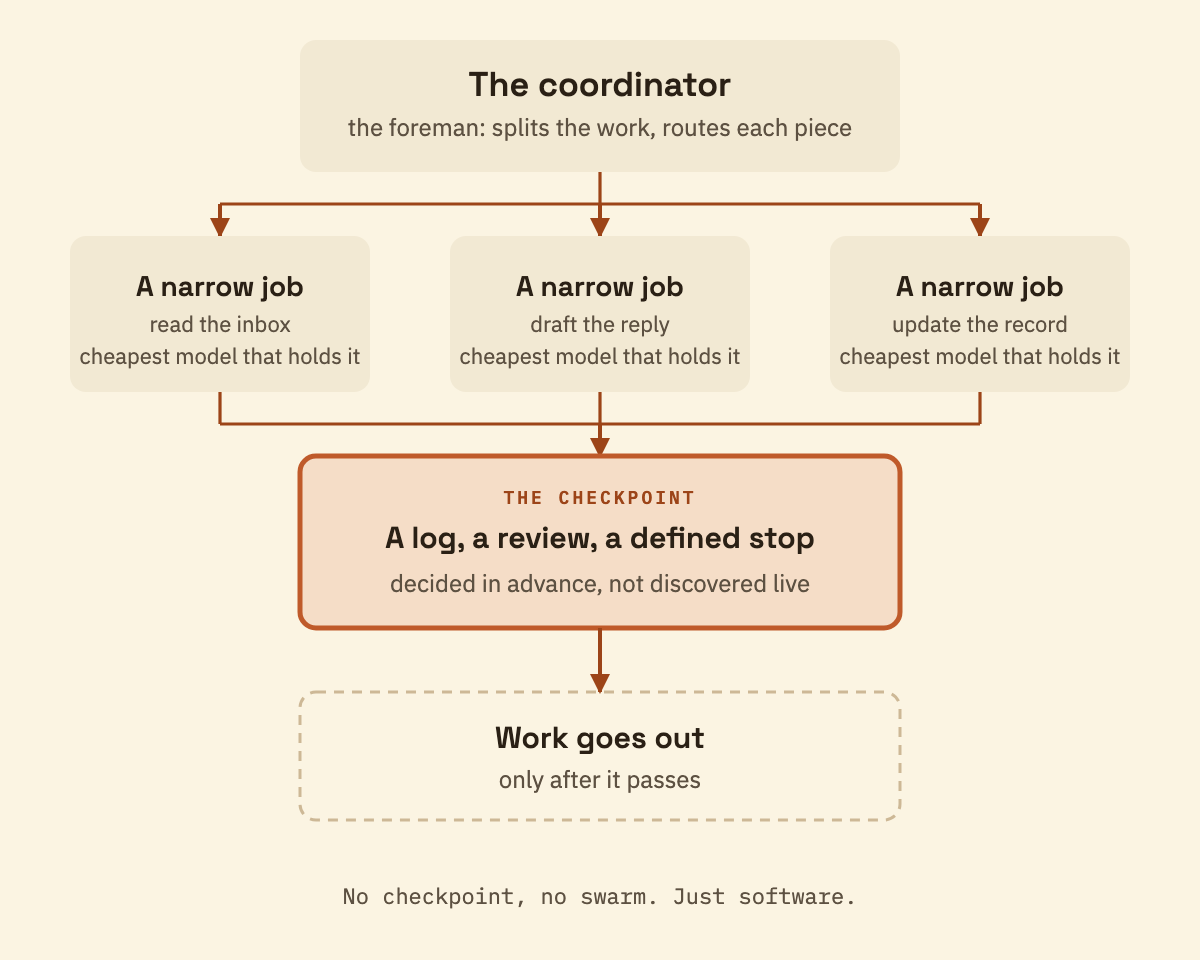
What it often means in a pitch: "our product makes more than one AI call." That is not a swarm, that is software.
The question that separates the two: ask what happens when one of the steps is wrong. A real setup has a checkpoint, a log, and a defined stop. If the answer is vague, the swarm is a diagram, not a system.
I'm 54, and I started two years ago
For everyone later in their career who thinks this train has left: it has not.
|
Two years ago I knew very little about AI. I had touched machine learning at a previous startup, but that was narrow, technical, and nothing like what came next. Then ChatGPT arrived in November 2022, and like most people I typed my first question out of plain curiosity.
Since then I have made it my mission to figure out what this technology means for my own career, and for building companies. Everything you are reading came out of that run: the workflows, the system thinking in today's lead, the studio I run now. Not because I was early, and not because I was technical. Because I treated learning it like a working project: an hour at a time, on real work, every week.
And in talking to people, I keep finding the same thing. Friends, business partners, family. People my age and younger, running companies or working inside small ones, all circling the same quiet question: is it too late to catch up? It is not. The tools have never been easier to start with than they are this month. And experience is an advantage here, not a handicap: you already know what good work looks like, and that is the hard part. The AI is the easy part.
If that is you, here is how I would start. Keep reading issues like this one, and forward this one to the person who came to mind while you read it. Reply and tell me what you want to learn; I am putting together live education sessions and webinars, and the replies are shaping them. And keep an eye on this newsletter over the coming weeks. There is more coming for readers who want to go deeper.
Talk Wednesday
One question back to you, and the fastest way to reach me.
|
|
Which tool are you quietly afraid you bet wrong on?
New name, same deal. Reply and tell me which one, and I will tell you how much of it you would actually keep in a switch. I read every reply, and the answers shape what I break down next. It comes straight to me. [email protected]
|
See you next Wednesday. The archive now lives at manual.praxisx.co, and the old links forward. Marc Marc Kleinmann · The Company Builder's Manual |
